Facts About Kylemore Abbey That Will Surprise You
The short answer. Kylemore was built as a love token, blasted into a mountainside, sold to a duke, and then became home to nuns who had fled a war. Its garden once had 21 heated glasshouses and grew bananas. Here are the facts that surprise visitors most, each with the part of the estate where you can see it for yourself.
Kylemore looks like a castle from a fairy tale, and that is where most people stop. The story you walk into is odder and sadder than the picture. It takes in a surgeon who became a politician, a wife who died young on holiday, a duke with money troubles, and a community of Irish nuns whose home was destroyed in Belgium. Everything below comes from the abbey's own history, and where the abbey's pages disagree with each other, we say so. You can see most of it for yourself on the day, and the table at the end tells you where.
It began with a honeymoon
Mitchell Henry, a Manchester-born surgeon of Irish descent, came to Connemara on honeymoon with his wife Margaret in the 1850s. They loved the valley. Years later he bought the land and built her a house there. Margaret laid the foundation stone herself, on 4 September 1867. You meet the pair in the speaking portraits of his library.
They used dynamite to fit it into the mountain
The house sits hard against the slope of the mountain behind it. To set it there, the builders blasted the rock with dynamite. The architect was James Franklin Fuller, and the finished house had 33 bedrooms, 4 bathrooms, a ballroom, a billiard room and a gun room. It cost a little over £18,000. Stand in the car park and you can still see how the mountain rises straight up behind the roofline.
The builder became an MP
Mitchell Henry did not stay a surgeon. He was elected Liberal MP for Galway, served for 14 years and was one of the founders of the Home Rule movement. At Kylemore, the Henrys planted 300,000 trees on the estate.
The name means "big wood"
Kylemore comes from the Irish Coill Mhór, "big wood". Those 300,000 trees help explain it. The woodland is now described as a temperate "Celtic rainforest", and the estate still covers 1,000 acres.
The story turned on a holiday in Egypt
In 1874 Margaret fell ill on a trip to Egypt and died, aged 45, the mother of nine children. Her body was embalmed in Cairo and brought back to Kylemore. By local lore it lay in a glass coffin under the staircase while her husband planned her memorial. The abbey tells that part as lore, and so do we.
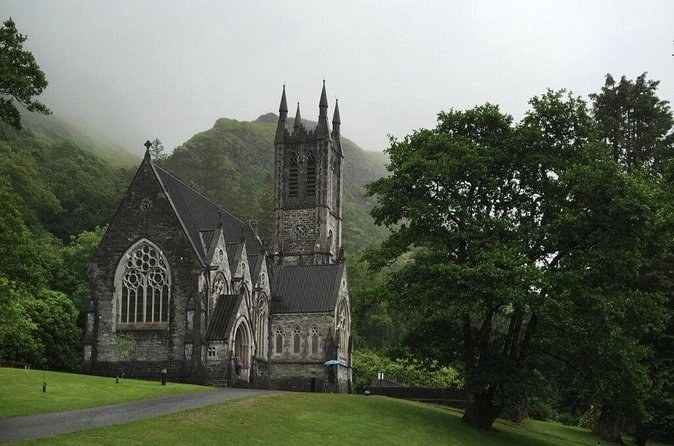
The church is a memorial, and it has no gargoyles
Mitchell built the Neo-Gothic Church for Margaret, finished in 1881. The abbey calls it a cathedral in miniature. Its columns use marble from all four provinces of Ireland: green Connemara, black Kilkenny, red Cork and white Tyrone. Where you would expect gargoyles, there are flowers, birds and angels.
They are buried in a small brick building, not the church
You might expect the couple to lie in their grand church. They do not, and you could walk past their grave without noticing it. Margaret was placed in the small red-brick Mausoleum on the avenue, and Mitchell, who died in London in 1910, was laid beside her. In 2015 and 2016 two of their direct descendants came to visit the grave.
A duke bought it, and the cards story is probably wrong
The Henrys sold Kylemore in the early 1900s to the 9th Duke of Manchester and his American wife, Helena Zimmerman. The abbey's pages give the year as 1902 in one place and 1903 in another. The Duke and Duchess left in 1914. Local legend says he lost the house at cards. The abbey thinks the likelier cause was money trouble after his father-in-law, Eugene Zimmerman, died.
The nuns came from Ypres
This is the fact that surprises most visitors. The Benedictine nuns who settled at Kylemore were an Irish community that had lived in Ypres, in Belgium, since the 17th century. Their abbey there was founded in 1665 and made over to the Irish nation in 1682. The First World War destroyed it, and in December 1920 the community reached Kylemore. It is the oldest of the Irish Benedictine abbeys.
Some of that community went to Dublin in 1688, at King James II's request, and went back to Belgium after the Battle of the Boyne. The history of Kylemore Abbey has the full timeline.
It was a girls' school for almost 90 years
The nuns opened Kylemore Abbey School in 1923 with 30 pupils. It ran as a boarding and day school for girls until the last students sat their exams in June 2010. A guesthouse on the estate closed after a fire in 1959. Today the University of Notre Dame, from Indiana, has a Global Gateway on the estate.
The garden was lost, then rebuilt from brambles
After the Henrys, the walled garden became a working kitchen garden for the nuns and the school. By the 1990s it was overgrown. A restoration led by Sr Magdalena FitzGibbon brought it back, and it reopened on 13 October 2000. It won a Europa Nostra award in 2001. Today it plants only varieties grown before 1901. The whole story is in the Victorian Walled Garden.
A giant left a stone behind
Legend says the giant Cú Chulainn lived on Duchruach, the mountain behind the abbey. In a fight with Fionn McCool across the valley, he threw a huge stone. It missed and landed on the estate, shaped like an old iron. That is the Giant's Ironing Stone. Children stand with their backs to it, make a wish and throw a pebble over it three times.
Where each fact lives on the estate
| The fact | Where to see it |
|---|---|
| The honeymoon and the house | Mitchell Henry's Library and Study |
| Margaret's only portrait | The Drawing Room |
| The four marbles | Inside the Neo-Gothic Church |
| The Henrys' grave | The Mausoleum, past the church |
| The nuns from Ypres | The Flight From Ypres room |
| The Vinery and the glasshouses | The Victorian Walled Garden |
| The wishing stone | On the estate grounds; ask at the visitor centre |
Longer tours with more time at the abbey
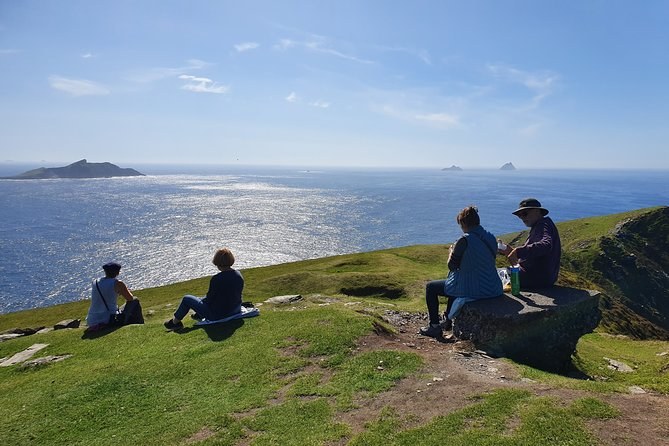
10 Day Wild Irish Experience Small Group Tour From Dublin
Ten days from Dublin in a group of 16 at most, with three hours at Kylemore and entry to it and the Cliffs of Moher in the fare.
From $3,393 per person
Check Availability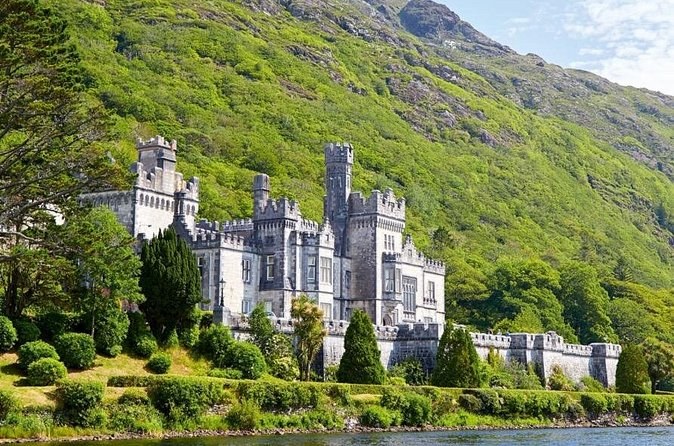
Connemara and Galway Private Chauffeur 2 Days Tour from Dublin
Two days from Dublin in a private car for up to three, with about five hours at Kylemore. Hotels are not included.
From $3,043 per group, up to 3
Check AvailabilityNext: read the rooms in order before you go, then book the time to see them. Every fare sits side by side on Kylemore Abbey Tours.